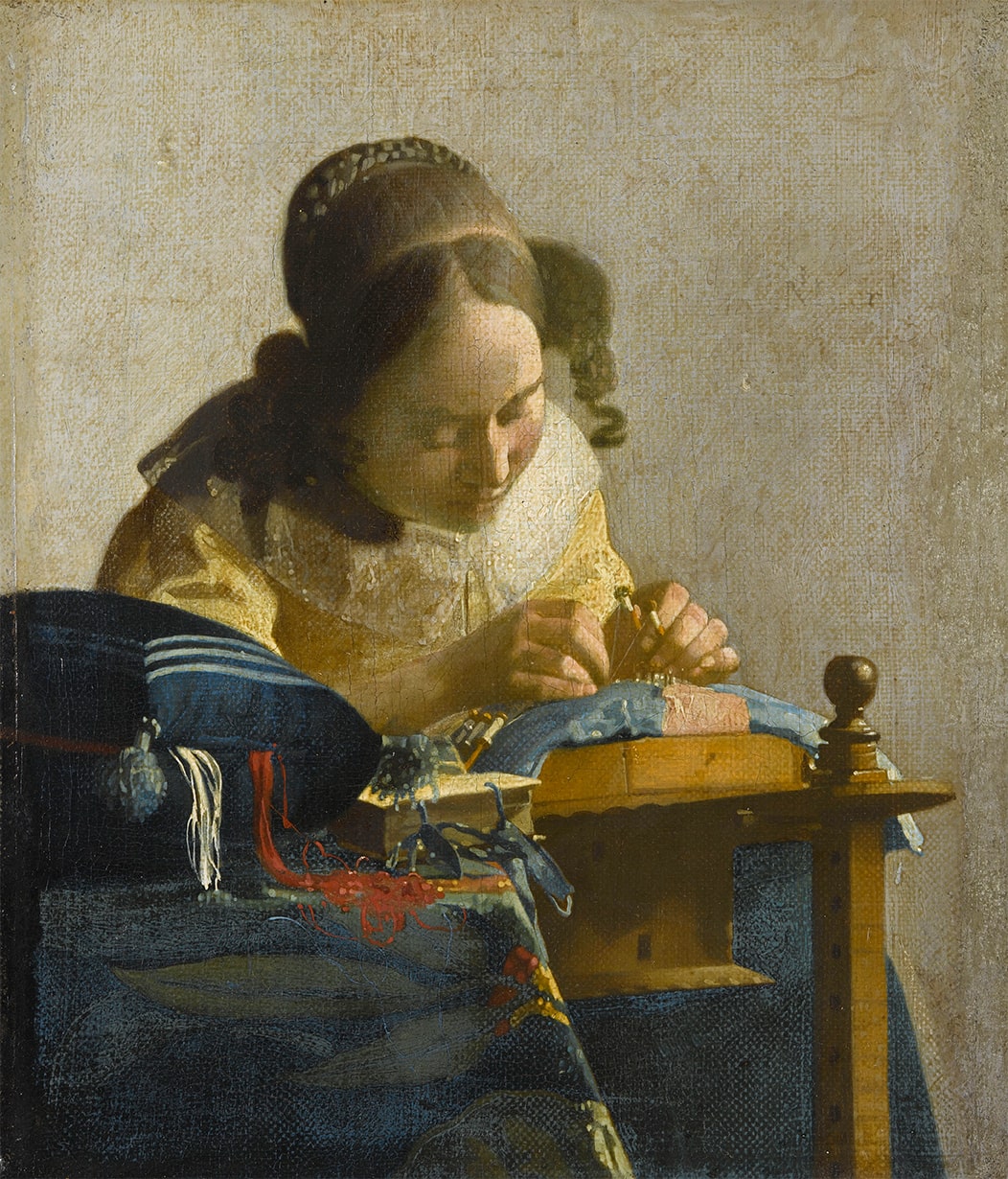
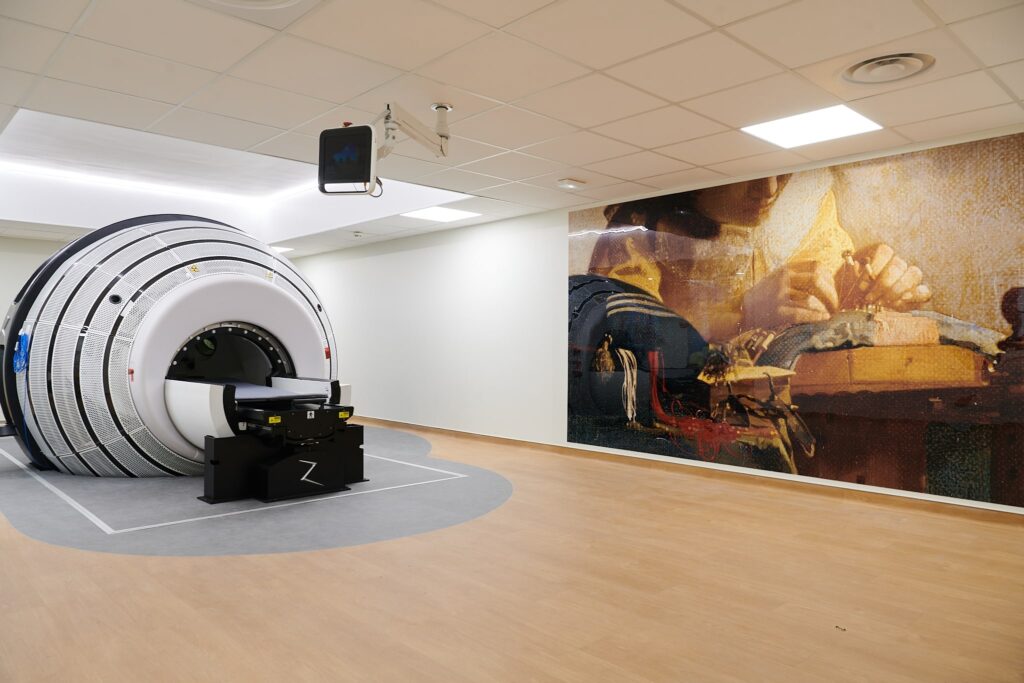
 At the crossroads of art and medicine, an unexpected collaboration brings masterpieces of the past into dialogue with the most advanced technologies. At Hôpital Lariboisière, the installation of ZAP-X went hand in hand with an important artistic choice: Vermeer’s The Lacemaker, an emblematic painting from the Louvre, was chosen to embody the precision and delicacy of the therapeutic gesture.
What does this work reveal about the gaze, light, blur and concentration? What does it tell us about our relationship with knowledge, images and the intelligence of gesture? Interview with Mr Blaise DUCOS, Chief Curator at the Musée du Louvre.
What does Vermeer’s Lacemaker mean to you, both artistically and symbolically?
Blaise DUCOS – Proof that originality is possible! There are other paintings of lacemakers by the artist’s contemporaries, but the one in the Louvre rejects their stereotypical or expected aspect, and gives the subject a fresh look.
Symbolically: the mystery of a presence.
How does this work fit into Vermeer’s oeuvre as a whole?
B.D – Along with the Milkmaid, in Amsterdam, this is his most important painting.
The painting is renowned for its technical finesse. Can you tell us about Vermeer’s precision of gesture and use of blurred areas?
B.D – The blur in Vermeer’s work refers to his knowledge of the camera obscura, an optical device that was very much in vogue in his day, and in his home town of Delft, which had a keen interest in such matters.
This is the whole question of suggestion in art – we know that our perception is partly made up of expectations and, literally, divinations. We guess as much (?) as we see.
This style is Vermeer’s way of criticizing a painting obsessed with precision. La Dentellière is precisely the place where blur and precision are juxtaposed…
Vermeer was a true master of light. Do you think his way of sculpting the invisible with light echoes what radiosurgery achieves today with radiation?
B.D – Vermeer plays with the implicit aspects of vision; it seems to me that medical imaging unveils, reveals, a little like stratigraphy.
Vermeer would certainly have been fascinated by the technical advances of the 21st century!
The choice of this artwork to illustrate the ZAP-X is a bold one. Were you surprised that it was asked to accompany such innovative technology? What do you think it says about Vermeer’s universality or modernity?
B.D – I was even struck by doubt, initially – which prompted me to suspend judgment (Descartes!) and try to understand. The explanations of the precise, fine and decisive gesture helped me.
More generally, when you study the universal, you’re always up to date – I’m often asked about the contemporary relevance of past geniuses!
It’s important to understand that the conversation with the best minds in history can be constantly taken up, continued, relaunched and expanded.
How does the Louvre envisage this type of collaboration with the medical world?
B.D – In my opinion, it’s a commitment that makes sense in situations on the ground that are always very diverse, and that challenge each and every one of us. This “case by case” approach is based on the notion of solidarity – that’s my feeling.
In your opinion, can art help to improve understanding of scientific advances that are sometimes complex for the general public?
B.D – The doxa has separated artistic culture from scientific culture, but the two are historically intertwined.
A project like this shows that high-tech can be enlivened, or complemented, by recourse to art history. It’s a story that can be told, and one that everyone can relate to.
What do you personally retain from this collaboration with AP-HP?
B.D – Every day, I’m more and more convinced that there are different forms of intelligence, and it’s wonderful to see them in dialogue. I’d like to thank Dr. Nataf and Mrs. Beetschen for their warm welcome.